App Dev for All Blog

Code on the Go release notes – 26.38

This release contains the upgraded toolchain! Follow the steps in the migration guide to update existing projects. Plus, new Document Outline and other features and fixes.

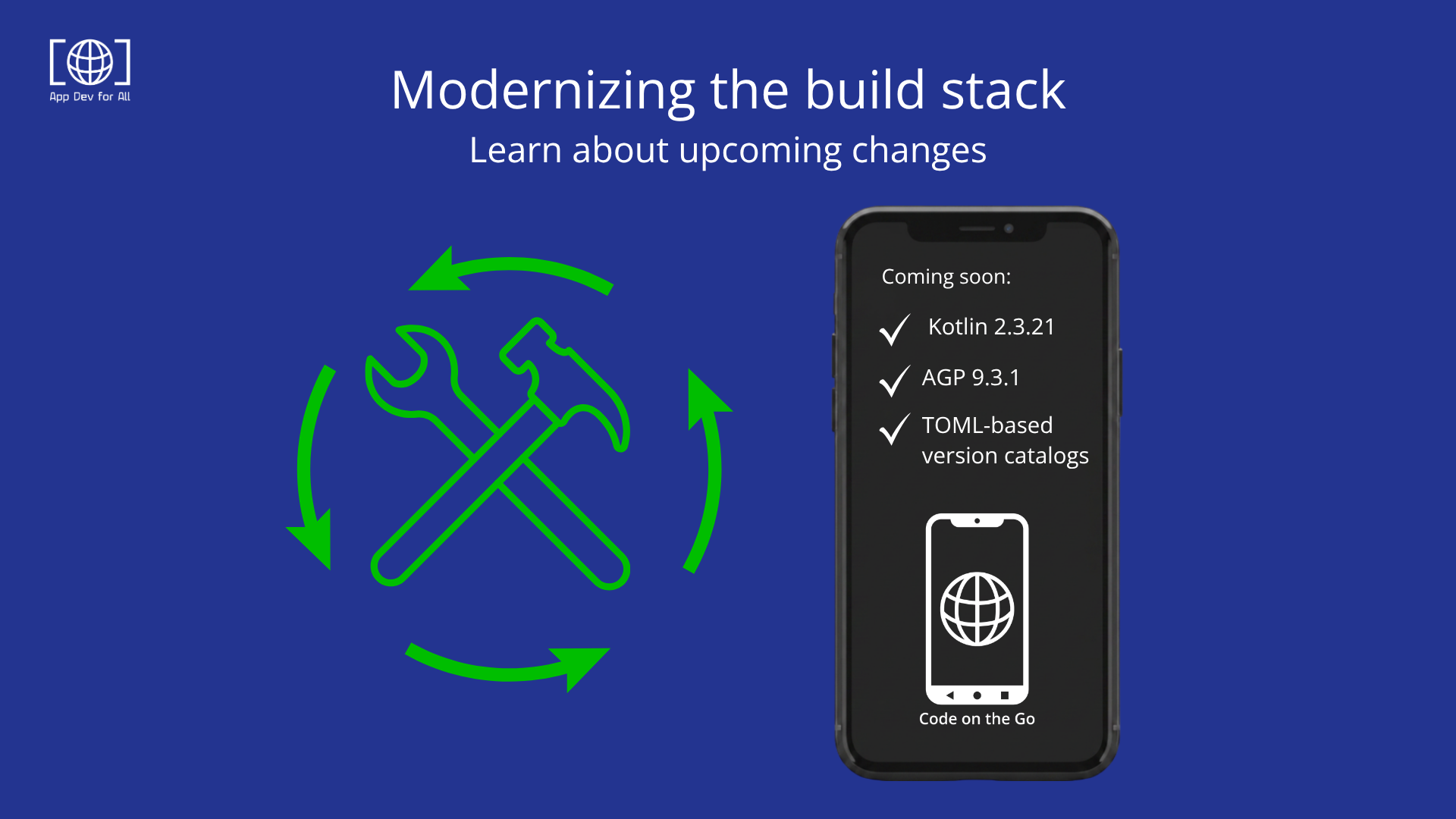
Modernizing the build stack (release 26.38)

In release 26.38, the core build stack is upgraded to Kotlin 2.3.21 and Android Gradle Plugin 9.3.1 (with Gradle 9.6.1). TOML-based version catalogs are also available,. Learn about these changes, including the steps to take to ensure your projects build.

App Dev for All Launches Knowledge to Go, Turning Android Phones into Offline Libraries for the World’s Unconnected Communities

This free and open-source Android app that transforms virtually any Android phone into an offline content server, sharing educational, medical, and technical resources with anyone nearby over local Wi-Fi. No internet required.

A Library in Your Pocket: The Journey of Knowledge to Go

Knowledge to Go (K2Go) is an upcoming Android app that turns any phone into an offline library server, delivering Wikipedia, digital books, maps, and educational resources without an internet connection. This post tells the story of how it was built, from the open-source Internet-in-a-Box foundation it stands on to the App Dev For All engineering that made it accessible to anyone.

Code on the Go release notes – 26.37

Read important news about our upcoming toolchain upgrade! Release 26.37 includes support for deep links, a new Java-language code action, and more.

Reviving a 2014 Samsung Galaxy S5 to run CoGo’s full Android build toolchain

What's the oldest device that can build an app with CoGo? The Samsung Galaxy S5 is now the current record-holder. And, the same S5 is an excellent client app for Knowledge to Go (K2Go).

Code on the Go release notes – 26.36

New features include Git branch management, a new Extensions Manager, and a new Kotlin code action. Plus, a list of recent tutorial videos on YouTube and Bilibili.

Code on the Go release notes – 26.35

IMPORTANT: In next week's release, we're updating the toolchain in the 64-bit app. Find out how to migrate your projects safely and easily.

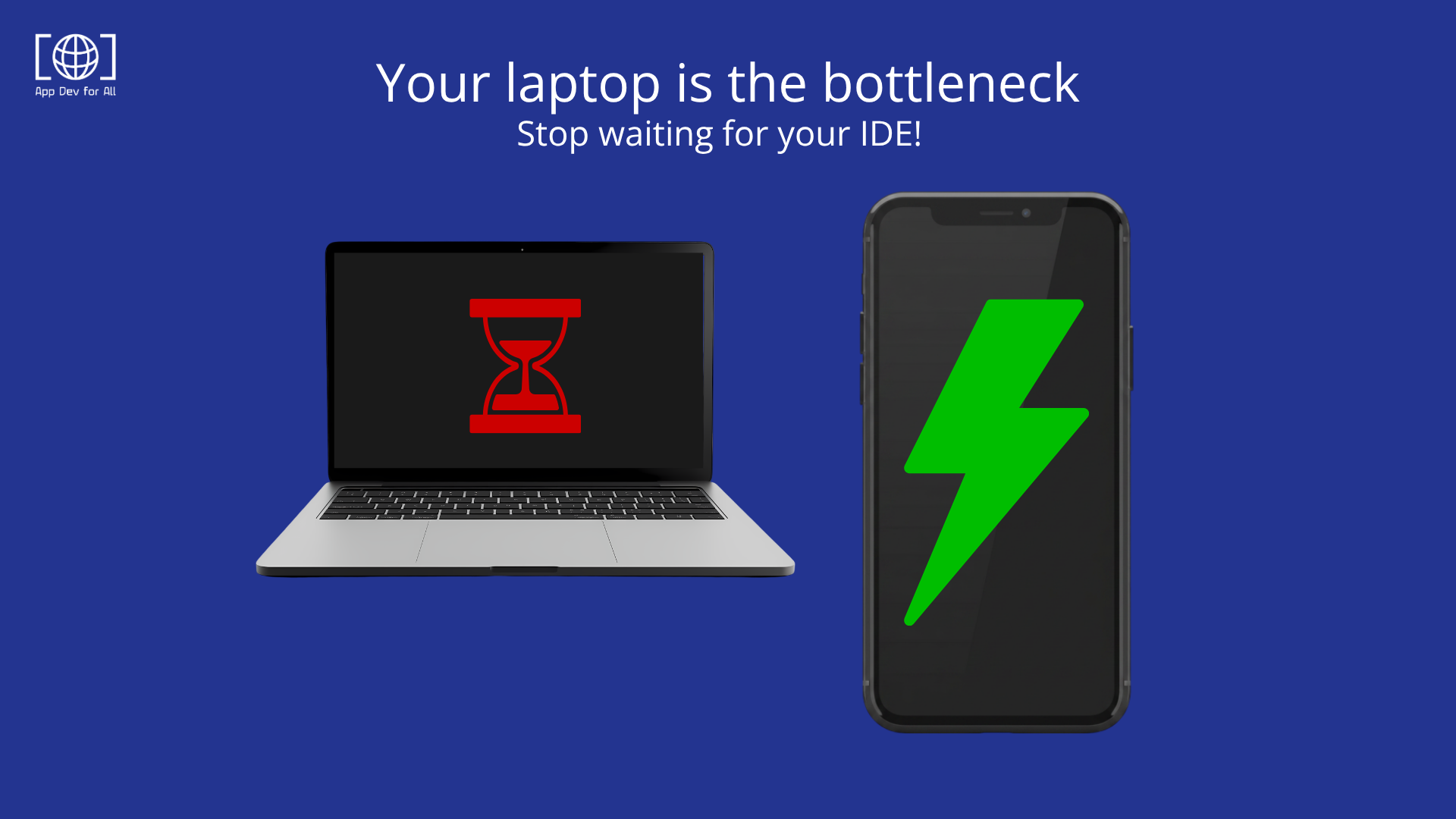
Stop waiting for your IDE

A phone-native IDE like CoGo can outrun a desktop IDE on a laptop because software built for the device it runs on doesn't waste cycles on decades of backward-compatibility layers. At the 2026 HOPE conference, we demonstrated two features designed to help you build apps faster.

Code on the Go release notes – 26.34

This release includes clearer opt-in text and several other improvements.

Code on the Go release notes – 26.33

This release includes new plugins, support for floating editor windows, better filtering on the list of saved projects, Git UI improvements, and more.

Code on the Go, your way: the plugin library is growing

CoGo's expanded plugin library lets developers install only the plugins they need, keeping CoGo lean enough to run well on even resource-limited Android phones.

Built with CoGo: AVO Player

This high-performance media player available in the Play store was built with Code on the Go.

Code on the Go release notes – 26.31

This release includes new plugins, support for floating editor windows, better filtering on the list of saved projects, Git UI improvements, and more.

Our partnership with the Offline Internet Consortium

We're partnering with the Offline Internet Consortium on our shared mission: bringing crucial digital resources, educational materials, and skill-building tools to communities in low-bandwidth or entirely offline environments.

Build the IDE you want: Introducing plug-in tiers

Creating a professional-strength IDE with the smallest possible footprint is a challenge. Our answer is fractionalization, so you can download only the plugins you need for the capabilities you want.

From consumers to creators: Breaking barriers to app development at CSTA 2026

New Orleans in July is not for the faint of heart. But the heat outside was matched by the energy inside the convention center, where CS educators from around the country gathered for the Computer Science Teachers Association (CSTA) 2026 conference. Through a generous grant from the Offline Internet Consortium, I represented App Dev for […]

Built with CoGo: Daily Wallpapers

This app lets you select and manage wallpaper images and offers new images daily. Published on F-Droid, it was built using Code on the Go.

Code on the Go release notes – 26.26

Our support community is moving to GitHub Discussions! Updated features include easier project naming, a live project performance graph, and more.

Curaçao 2026: Together again, building what’s next

The ADFA team's annual in-person retreat in Curaçao focused on two themes: getting developers to "Done!" faster and using offline-capable AI more effectively. A team hackathon produced several promising proofs-of-concept for new CoGo features, which the team will continue refining with an eye toward possible release as experimental features for feedback from our user community.

Your phone is the only computer you need

Code on the Go eliminates the need for a second computer when building Android apps, a problem that's existed for decades in app development. For the hundreds of millions of people worldwide whose only computer is their phone, this isn't just convenient, it's what makes Android development possible at all for them.

New plugins power the CoGo open ecosystem

Code on the Go's plugin system gives you access to a lean, personalized IDE by letting you choose only the plugins you actually need, which matters especially on a phone where storage is limited. We've just released a new batch of community and ADFA-built plugins covering everything from Sketch-to-UI and Python/Flask support to a Material icons library, a custom NDK environment, and a billable time tracker for freelance developers.

Code on the Go release notes – 26.23

This release includes five new plugins, including a Material icons repo, an ultra-fast NDK environment, Sketch to UI (now a plugin), a time-tracking solution, and experimental Python/Flask support.

Our first community code contribution made Code on the Go speak

CoGo received its first community pull request from a visually impaired developer who added TalkBack screen reader support to the app's toolbar. The contribution is a practical example of open source development working as intended: a user who needed the tool to work better fixed it themselves, and contributed that fix back to everyone.